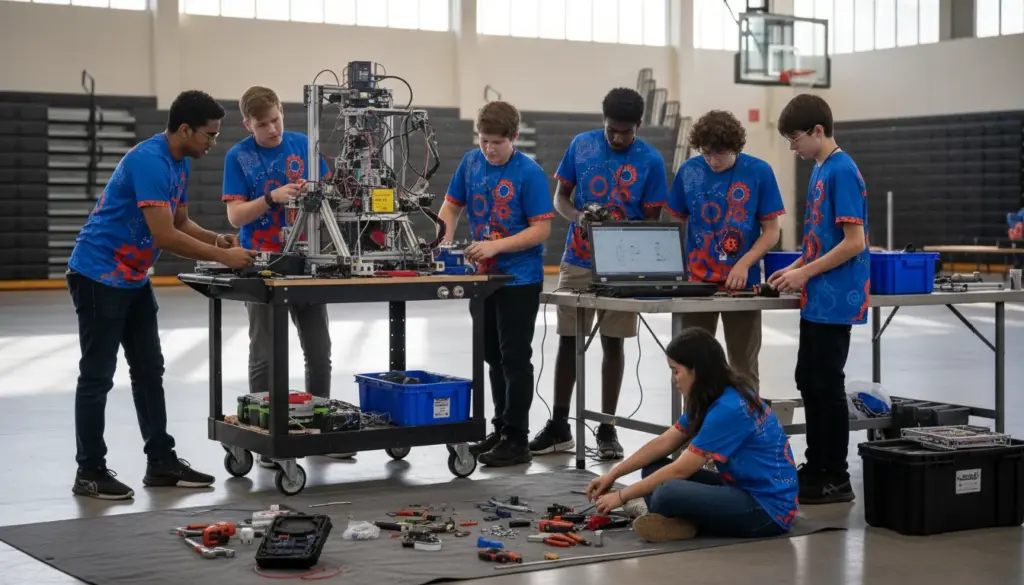
You can spot a robotics team at an airport from twenty metres away. They are the ones wheeling a black crate the size of a small suitcase, covered in sponsor stickers and held together with zip ties and hope. Inside is a machine they have designed, coded, rebuilt at 2 a.m. and argued over for months. That crate holds more engineering lessons than any textbook, and it is heading for a competition field where the only thing that matters is whether the robot works.
For students in many regions, robotics competitions have moved from niche hobby to a serious pathway. They teach the kind of skills that admissions officers and employers actually look for, because a robot is brutally honest. It drives or it does not. It scores or it tips over. That clarity is why robotics is the activity engineering faculties trust most. The challenge is choosing the right competition, because the word covers everything from a 25-centimetre autonomous cube to an industrial-sized alliance machine built by a team of thirty.
Why Robotics Competitions Carry So Much Weight
When an admissions reader sees a robotics competition on an application, they see evidence that cannot be faked. A student who helped build a machine that competed at a national event has receipts: match scores, engineering notebooks, photos of a very real robot on a very real field. Asadbek from Uzbekistan turned his robotics passion into a full scholarship for a BSc in Robotics Engineering at Arizona State. Imanali from Kazakhstan built his path to the University of Pennsylvania on the back of competition seasons. Fahim from Bangladesh reached Haverford College with robotics Olympiads behind him, describing the experience as what let him turn a love of computers into physical creations.
The skills stack up quickly. Students learn to design under constraints, because every competition has a rulebook that limits motors, weight and size. They learn to programme autonomous routines that must execute in fifteen or thirty seconds with no human input. They learn to troubleshoot when a sensor fails five minutes before a match. And they learn to work with a team under pressure, which is the part that surprises most newcomers.
The Arena Giants and Autonomous Challenges
FIRST Robotics Competition for High School Teams
This is the heavyweight division. Starting with a standard Kit of Parts, teams of high school students design, programme and build industrial-sized robots to play an action-packed game released each January. They compete on a themed field as part of a three-team alliance, which introduces a strategic layer most competitions lack. Your robot might be brilliant at scoring, but if it cannot work with two unfamiliar partners, the alliance loses. The programme calls this Coopertition, and it forces students to think beyond their own machine.
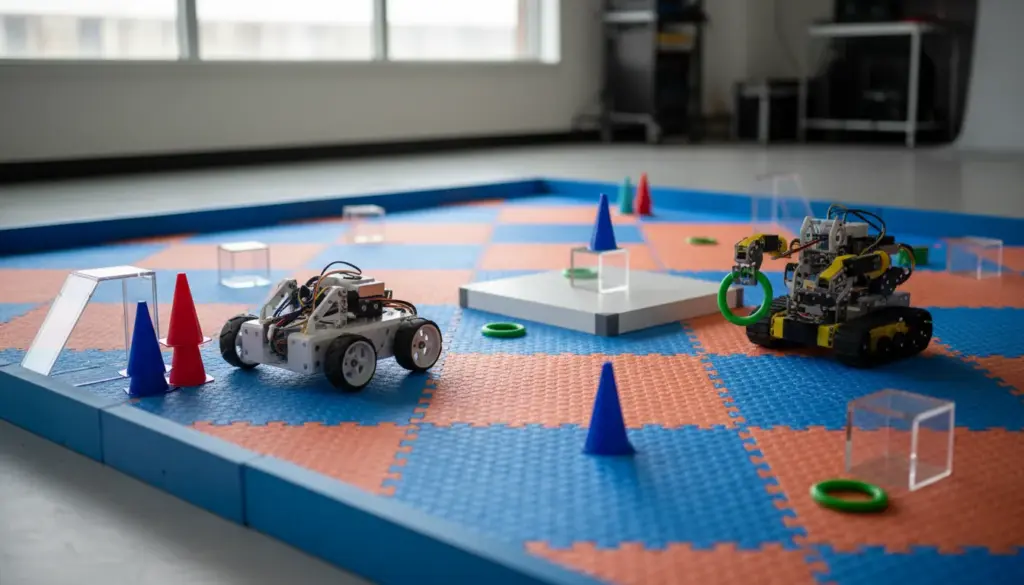
The 2027 season is called FIRST CANOPY, and the new challenge is BIOCORE presented by Haas, which will send teams into the systems that sustain life on Earth. The game reveal happens on 9 January 2027, and the best way to understand the programme is to attend a local event and meet teams in person. VEX V5 is the largest robotics competition in the world by team count, with a format that is elegantly simple. Two alliances of two teams each compete on a twelve-foot square field, and every match opens with a fifteen-second autonomous period before drivers take over. That autonomous window is often where matches are won or lost, rewarding careful programming above raw driving speed.
Divisions are age-based rather than grade-based, which helps when your school system does not map neatly onto American grades. Middle School is for students aged fifteen or younger at the World Championship, and High School is for those nineteen or younger. Team registration costs two hundred US dollars for American teams, plus a separate fee set by each qualifying event. The real draw is the global reach: VEX events happen on every continent, and the pathway from local tournaments to the World Championship is clearly mapped.
VEX AI and World Robot Olympiad for Advanced Builders
Once a team has outgrown the standard VEX kit, the AI competition is the natural next step. It uses the same field but removes the driver entirely, with robots running fully autonomously using GPS, robot-to-robot communication links and an AI vision system. Each team builds two machines that must work together, and the rules are unusually open. Teams can use 3D printed and machined parts, custom electronics, and there is no limit on motor count. The programming demands are significant, requiring two robots to coordinate movements and execute a shared strategy without a human touching a joystick.
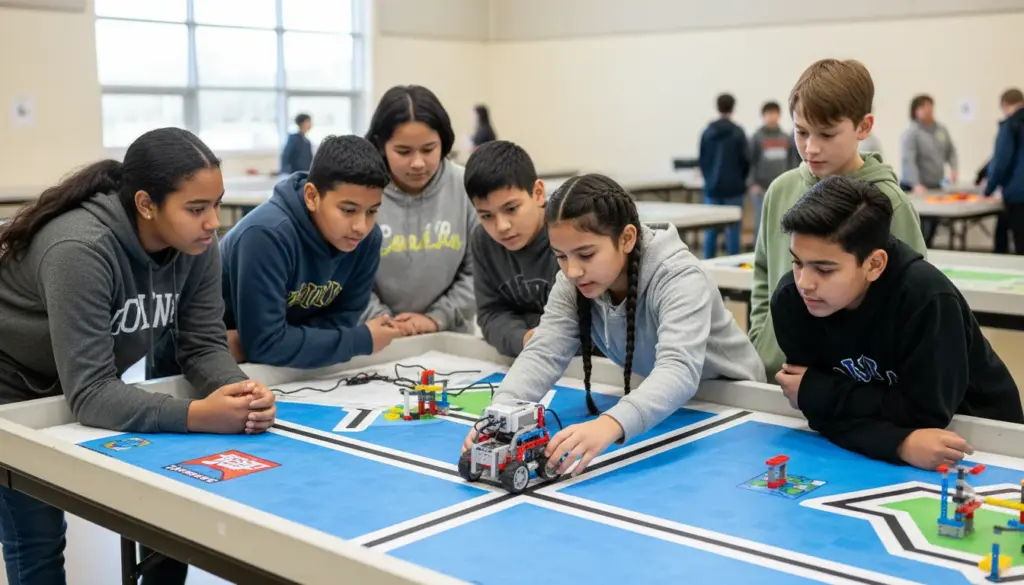
The World Robot Olympiad, or WRO, runs the most internationally accessible robotics competition there is. Tournaments happen in over ninety-five countries, with more than thirty-two thousand teams competing each year across three age groups from eight to nineteen. Teams of two or three with a coach build an autonomous robot no larger than twenty-five centimetres per side to solve challenges on a tabletop field. Hardware and software choices are free, so teams are not locked into one manufacturer’s ecosystem. This flexibility matters for families watching their budget, and local WRO affiliates in many regions run regular workshops and qualifiers.
Middle School Entry Points and Virtual Options
Younger students need competitions that match their attention spans and skill levels. The FIRST LEGO League Challenge is designed for grades four through eight, and it hits a sweet spot between structure and creativity. Teams design, build and programme an autonomous robot using SPIKE Prime technology, then compete in a low-stress, friendly match format. Students learn to explain their design choices to judges, which builds communication skills early.
The Regional Autonomous Robotics Circuit, or RARC, offers a different model by bringing competitions into local schools and community centres. Its CYBER contest is a virtual cybersecurity game played in a capture-the-flag format, which means students compete from their own classrooms with supplied materials and guidance. Hosting events locally cuts travel costs and makes participation possible for families who cannot commit to international trips. The focus is on collaboration, critical thinking and problem-solving in a STEM context, without the pressure of a stadium full of spectators. For students who prefer coding to building, VEX also runs virtual competitions where competitors stay at home and participate online, testing coding and virtual collaboration skills in timed rounds.
Here are the key competitions to consider when you are ready to start. In programs like the FIRST Robotics Competition, high school teams design and build industrial-sized robots from a standard kit of parts to compete in an annual game released each January. Teams also create an identity, raise funds, and promote STEM in their community while guided by adult mentors. This 360-degree learning experience culminates in matches where alliances of three teams work together in a spirit called Coopertition.
Starting a Team and Finding Your First Event
The hardest step is always the first one, but the infrastructure exists to help. Most competition websites have a team and event search tool that lets you find active groups in your area. Attending an event as a spectator is the single best way to learn what a competition actually feels like. You will see the pit area where teams frantically repair robots between matches, the queue of nervous drivers waiting for their slot, and the moment a machine that failed all week suddenly scores perfectly. That energy is impossible to describe and essential to experience.
Costs vary widely, but they break into three categories: registration fees, materials and travel. FIRST and VEX publish detailed cost breakdowns on their websites, and many teams offset expenses through local sponsorships from engineering firms and technology companies. WRO keeps costs lower by allowing any hardware, which means a team can start with equipment they already own. In many regions, several schools run established robotics programmes that welcome new members, and local WRO and VEX networks are active and growing each season. Find a local event, walk through the doors and watch what happens.